
Unfortunately we don't fully support your browser. If you have the option to, please upgrade to a newer version or use Mozilla Firefox, Microsoft Edge, Google Chrome, or Safari 14 or newer. If you are unable to, and need support, please send us your feedback.

Elsevier
Publish with us

AI in R&D: Keys to successful adoption and scaling

Explore the challenges and opportunities of adopting AI to accelerate R&D.

The state of AI in R&D in 2026

Most R&D-intensive organizations have begun experimenting with AI, but most have not been able to move beyond isolated pilots. Only 22% of life sciences leaders say they have successfully scaled itopens in new tab/window — and just 9% report achieving significant returns on their investment. 

AI success in R&D depends on four connected priorities: building trust, protecting data and IP, choosing the right tools and building the human capability to use them effectively. Also, AI tools grounded in curated, peer-reviewed scientific content produce significantly fewer errors and more traceable outputs on research tasks than general-purpose tools trained on broad internet data.

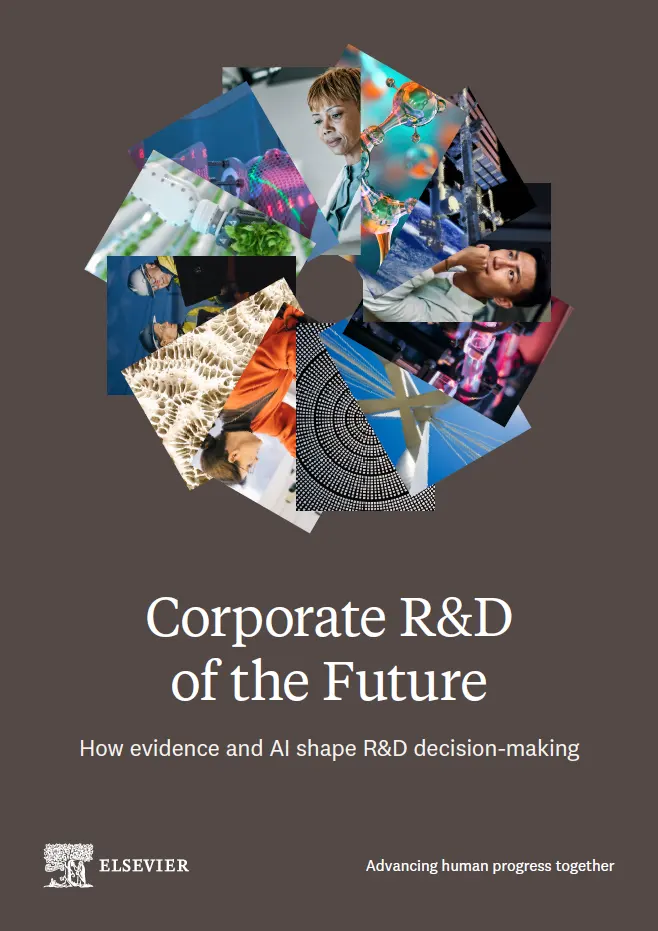
Corporate R&D of the Future - Report Cover

Read the latest findings from the Corporate R&D of the Future report

See what they're saying opens in new tab/window

Discover the elements of successful AI in R&D

How can R&D organizations build trust in their AI?

Trust in AI for scientific research depends on four foundations: validated, curated data; model outputs tested against domain-specific ground truth before deployment; reproducible, auditable processes; and transparent governance that researchers can see and understand. 

Purpose-built research AI — designed around curated scientific datasets rather than broad internet data — consistently delivers more reliable, traceable results than general-purpose tools. 

Why is internal privacy and security critical to successful AI in R&D?

AI tools introduce three distinct privacy and security risks that do not exist in conventional solutions for R&D. Research data entered as AI prompts may be used to train future models, data flows across jurisdictions in ways that trigger regulatory obligations and standard vendor contracts often lack the protections research organizations need. Addressing these risks requires explicit contractual terms, regulatory mapping and a clear incident response plan that go beyond a traditional IT security policy. 

How can I choose the right AI solution for my R&D workflow and AI ecosystem?

The most consequential AI decisions for R&D leaders are not which model to use — they are whether to build or buy, whether your data infrastructure can support AI and whether the organization has the people and processes to move from pilot to production.

Stuart Whayman_thumbnail_640x463

Read the "Corporate R&D of the Future" Report

The Corporate R&D of the Future report draws on a global survey of R&D and R&D connected professionals. It shows how organizations use data, evidence and AI to make decisions, where the barriers lie, and what they expect from the next five years. Dive into the findings to see how views differ by region, organization size and seniority, and why connected data, trusted evidence and AI are set to define the future of R&D.

Explore Elsevier's advanced data solutions supporting AI in R&D, including datasets, connectors and more

Young man working as software developer, coding on computer in modern office